Category: Time and Energy
By LeAnna J. Carey | Jan 07, 2013
Happy New Year to you! Have you thought about how you are going to be spending your time in 2013? We believe that wellness is going to be a key priority for many healthcare consumers who are interested in staying competitive and productive in the workplace. Here are four tips that may get your year off to a good start and keep your head in the game:
1. Getting enough sleep
Employers are not the only ones looking at performance and productivity – the Baltimore Ravens and San Francisco 49ers spent last summer looking into the relationship between sleep and performance. It might be good time for you to revisit the importance of keeping your room cool and dark, as well. Sleeping without your iPhone, iPad and laptop will keep you in sync with your body’s circadian rhythm.
2. Standing, not sitting
The need to exercise is very important to health and wellbeing. New research shows that cutting back TV watching to less than two hours every day may extend life by 1.4 years. According to WebMD studies suggest that people who sit for prolonged periods every day have a higher risk for diabetes, heart attack and even some cancers. All of us know how easy it is to spend several hours in front of a computer without taking a break - try to get up and move several times a day.
3. Recognizing peak creativity time
Start by asking yourself if you are a lark or an owl? If you are an owl, starting a project before 8 in the morning will most likely produce less than average results. Think back over your work for the past few months – was there a time when ideas just seemed to flow? Dr. Kay, Steve Kay, a professor of molecular and computational biology at the University of Southern California states that, “when it comes to doing cognitive work, for example, most adults perform best in the late morning - as body temperature starts to rise just before awakening in the morning and continues to increase through midday, working memory, alertness and concentration gradually improve. Taking a warm morning shower can jump-start the process.”
4. Finding Flow
Flow is the mental state in which a person performing an activity is fully immersed in a feeling of energized focus, full involvement, and enjoyment in the process of the activity. In essence, flow is characterized by complete absorption in what one does. What is key to flow and enjoying an integrated work/life balance is placing as much emphasis on your downtime as your work time.
Ready for 2013! We are and looking forward to sharing tips on health, energy, creativity, and wellness with you!
.
By Virginia Gurley | Aug 28, 2012
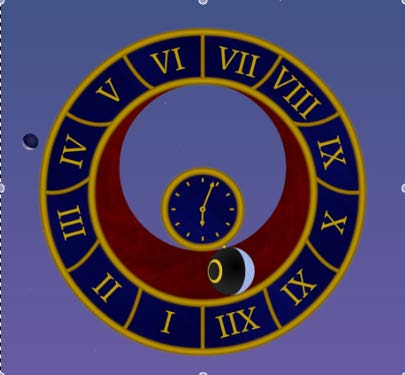
If you’re into science, the research revealing the inner workings of circadian rhythms is pretty fascinating. But intriguing as this science is, it’s not the same as directly experiencing in-the-moment attunement with solar time. It’s that direct experience of being in sync with the sun that awakens awareness of how powerful and fundamental the sun cycle is for our wellbeing and health.
Thanks to the good work of Yale and Jackie at Better Tymes Project, you can get a beautiful visual sync-up with your local solar and lunar time using their cool (free) screensaver, TrueTyme. I find myself drawn to checking in with the TrueTyme screensaver every few hours throughout the day and evening. It’s hard to put into words why this visualization of solar time is so alluring – it feels like a positive addiction.
Because I’m an iPhone user, I haven’t been able to check out their Android application, but I’m hoping that will change soon. Better Tymes Project is in the process of crowdsourcing funds so they can port True Tyme to the iOS platform. Please join AuraViva to support Better Tymes Project bringing their wonderful approach to visualizing sun and moon time to iPhone users everywhere!
By LeAnna J. Carey | Aug 27, 2012
"...we need to do a better job of putting ourselves higher on our own 'to-do' list," Michelle Obama.
A woman executive whom I have known for years informed me last week that she was stepping away from her work world for a few months in order to gain some balance and perspective. She said it was time to think differently on how she wanted to look back on her accomplishments; in other words, she did not want to sum it all up only with professional milestones. Without a vision that integrates the two, careers headed in the right direction can leave personal success in its wake. Why is that? Overwork and brutal hours may be the new demand, but they are also a ticket to becoming a member of the working wounded club, and nothing will gain you membership like random planning. My question is, how much time are you devoting to planning your personal best?
Here are three questions to jump start your best quest:
-
Where do your passions lie? Are you be able to identify activities or topics that you find energizing apart from your career ecosystem? Another way to think about this question is to ask what you like to accomplish while you are young and healthy?
-
Are you addicted to work? Medical oncologist, Edward T. Creagan, says in his blog "It's been my experience that an 'out of office' response means nothing anymore, we're driving ourselves wacko with no time to power down." If you suspect that you may be a workaholic, take this quiz ...then turn your iphone off.
-
Do your lifestyle decisions support your goals? Our master body clock is the link between our physical health and well-being. For example, lack of sleep directly impacts your creativity, ability to learn, and even control and prevent chronic disease. Your personal best requires good decisions.
I am well aware that innovators and entrepreneurs believe that the new currency is information - but, I think the new currency is leveraging time. It is easy to forget about personal fulfillment these days - take some time to remember what you want in life outside of the office.
"If you neglect to recharge a battery, it dies. And if you run full-speed ahead without stopping for water, you lose momentum to finish the race." Oprah Winfrey
By LeAnna J. Carey | May 18, 2012

George Eliot said that, "the important work of moving the world forward does not wait to be done by perfect men." Sounds like the perfect description of an entrepreneur. The other characteristic that entrepreneurs seem to share is that achieving work life balance is not their number one priority. According to Jeffrey Stibel, in his well-written Harvard Business Review article, Entrepreneurs Don't Need Work-Life Balance, entrepreneurs have “zero balance…we’re all in, all the time.” Like many, I do not disagree with Stibel, in fact I think he is spot on. What may resonate with entrepreneurs is that they do need energy to keep their unrelenting pace.
For entrepreneurs, productivity is a priority. Therefore, understanding the importance of syncing personal schedules with the body’s cyclic rhythms to increase energy levels is insight (and science) that will probably not frustrate the entrepreneur. Our daily ability to renew our energy levels is dependent on syncing light, food, temperature and activity cycles. While the majority of us fall back on familiar routines, the entrepreneur may not be aware that they are out of sync, have missed a meal, or have worked through the night to solve a problem. To realize their potential, entrepreneurs need to strategize personally and professionally on how not to run out of steam. Let's examine how we can renew our daily energy:
· Light. Think about how the built environment and the fast paced workday works against us with electrical lighting and spending hours inside buildings. Our bodies respond to the rhythms of night and day. For example, the release of melatonin is critical to rest...which is critical to energy. Take the time to go outside during the day for an energy blast.
· Food. Yes, we know - entrepreneurs eat on the run, but did you know that with one night of poor sleep, more calories (up to 500) will be consumed the next day? Start the day with a decent breakfast which syncs up with cortisol release to help transition to wakefulness.
· Temperature. Where do bats sleep for 16 hours of the day? A cool dark cave, I'll let you connect the dots.
· Activity. You need a plan to work out just as much as your business needs a plan. Your schedule is never going to open up for you to exercise; so let me ask you, how long have you been sitting at your desk today or how long has it been since you have taken a sip of water? Remember that research shows that regular exercise increases energy and reduces fatigue. While we all have the same 24 hours, entrepreneurs tend to overestimate what they can squeeze into their day.
Like all of us, entrepreneurs are on a journey, the difference with entrepreneurs is that they know they will regret not using every spare minute to follow their dreams - that's why they need energy.
By LeAnna J. Carey | Jan 12, 2012

After reading Tony Schwartz's last blog in Harvard Business Review on his positive experience of going off line for a set time I gave some thought to the different contours of happiness. To some, happiness is having a meaningful job, doing good, or perhaps not being sad. My 2012 question is, what actions must we take to be happy within our own lives? For starters, think about what makes you unhappy. What impacts my personal happiness is a sense of being spread too thin and watching my creativity and productivity evaporate.
I took my question to the Twitterverse and asked what actions my trusted pals intended to take to be happy this year. Here is a quick scan of some of the answers:
-
Respire Profundo and enjoy the moments
-
Less worry, focus/take action
-
Simplifying schedule, exercising, saying YES only when I truly mean it
-
WIN WIN WIN WIN
-
Trust God. Professionally? - stay open, continue learning/shifting
-
My actions start with "what do I want?" & really listening to my answer.
My question must have struck a cord, because a few of the forward thinkers want to check in with one another during the year to match up the happiness progress to the actions. If we take a look at these answers, it would appear that "how" to be intentional with the time we have would connect the answers in three ways:
-
Expectation. Ask yourself what your expectations are for yourself. Or better yet, as Elli St. George Godfrey said: ask, what do I want? Focus on becoming familiar with not only your strengths and talents, but your desires. It's time to get in sync and resist rolling into this year the same as the last.
-
Invest. We all have the same 24 hours, the difference is how we use that time. Just as Tony Schwartz mentioned in his blog, he realized how much time he was spending online - and began to feel that "The lure of email and the Internet had come to feel compulsive, irresistible, and increasingly uncomfortable." Where you spend your time should make sense, after all, we cannot get it back. Invest your time carefully; it was Emerson that said, thinking is the hardest task in the world. Have you set aside time to think?
-
Action. If last year is any indication of 2012 - where information, ideas, new market innovations moved at such a fast clip that feeling overwhelmed became the new normal. Chances are you not only lost some mojo, but some happiness as well. Identify and focus on actions that will lead to and maintain happiness. For some, that may mean going to sleep without their iPad next to them.
When racing to beat that deadline or keep up with the speed of the market try not to toss out happiness as if were insignificant. We have the ability to design how we spend our time, what we choose to focus on, and who we engage with - sounds like happiness to me!
A special thanks to@SMSJOE 098@bikespoke @3keyscoach @Tribe2point0 @Natasha_D_G @danielnewmanUV @ambercleveland for such generous responses. Can you guess who answered, win, win, win? It can only be one person....