By Virginia Gurley | Aug 28, 2012
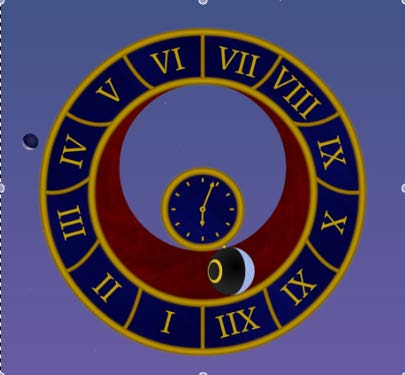
If you’re into science, the research revealing the inner workings of circadian rhythms is pretty fascinating. But intriguing as this science is, it’s not the same as directly experiencing in-the-moment attunement with solar time. It’s that direct experience of being in sync with the sun that awakens awareness of how powerful and fundamental the sun cycle is for our wellbeing and health.
Thanks to the good work of Yale and Jackie at Better Tymes Project, you can get a beautiful visual sync-up with your local solar and lunar time using their cool (free) screensaver, TrueTyme. I find myself drawn to checking in with the TrueTyme screensaver every few hours throughout the day and evening. It’s hard to put into words why this visualization of solar time is so alluring – it feels like a positive addiction.
Because I’m an iPhone user, I haven’t been able to check out their Android application, but I’m hoping that will change soon. Better Tymes Project is in the process of crowdsourcing funds so they can port True Tyme to the iOS platform. Please join AuraViva to support Better Tymes Project bringing their wonderful approach to visualizing sun and moon time to iPhone users everywhere!
By LeAnna J. Carey | Aug 27, 2012

"...we need to do a better job of putting ourselves higher on our own 'to-do' list," Michelle Obama.
A woman executive whom I have known for years informed me last week that she was stepping away from her work world for a few months in order to gain some balance and perspective. She said it was time to think differently on how she wanted to look back on her accomplishments; in other words, she did not want to sum it all up only with professional milestones. Without a vision that integrates the two, careers headed in the right direction can leave personal success in its wake. Why is that? Overwork and brutal hours may be the new demand, but they are also a ticket to becoming a member of the working wounded club, and nothing will gain you membership like random planning. My question is, how much time are you devoting to planning your personal best?
Here are three questions to jump start your best quest:
-
Where do your passions lie? Are you be able to identify activities or topics that you find energizing apart from your career ecosystem? Another way to think about this question is to ask what you like to accomplish while you are young and healthy?
-
Are you addicted to work? Medical oncologist, Edward T. Creagan, says in his blog "It's been my experience that an 'out of office' response means nothing anymore, we're driving ourselves wacko with no time to power down." If you suspect that you may be a workaholic, take this quiz ...then turn your iphone off.
-
Do your lifestyle decisions support your goals? Our master body clock is the link between our physical health and well-being. For example, lack of sleep directly impacts your creativity, ability to learn, and even control and prevent chronic disease. Your personal best requires good decisions.
I am well aware that innovators and entrepreneurs believe that the new currency is information - but, I think the new currency is leveraging time. It is easy to forget about personal fulfillment these days - take some time to remember what you want in life outside of the office.
"If you neglect to recharge a battery, it dies. And if you run full-speed ahead without stopping for water, you lose momentum to finish the race." Oprah Winfrey
By LeAnna J. Carey | Aug 06, 2012

No. I'm not reflecting on the 60's. I'm reflecting on the unrelenting and swirling change causing many of us to clutch our calendars as if grasping for time itself. Perhaps we have been too permissive with our time - letting others have it, watching stupid TV, or focusing only on the time we have at work. Here is my question for you; which is your most significant enabler - time or health - which would you choose? If you thought "I don't have time to think about my health," you are not alone - our daily schedules reflect our priorities and control over our schedules need not be elusive.
Here are a few clues that you are being too permissive with your time:
-
Take a look at your schedule these past two weeks - how much of that time went to helping others fulfill their goals with your time? The time demand of others can rob you of precious time to think about what's next for you, or recognize and respond to signals that will keep you healthy competitive, and confident. For example, in a survey by Perlow and Porter, posted in Harvard Business Review reviewed that professionals believed that the, “always on” ethic is essential if they and their firms are to succeed in the global marketplace. Just look at the numbers: According to a survey we conducted last year, 94% of 1,000 such professionals said they put in 50 or more hours a week, with nearly half that group turning in more than 65 hours a week. That doesn’t include the 20 to 25 hours a week most of them spend monitoring their BlackBerrys while outside the office. One of their observations was that responsiveness breeds the need for more responsiveness without considering how to work more effectively without considering how they could work better.
-
How much television are you watching? A study that appeared in The Journal of the American Medical Association*, researchers combined data from eight such studies and found that for every additional two hours people spend glued to the tube on a typical day, their risk of developing type 2 diabetes increases by 20% and their risk of heart disease increases by 15%.* Will you even remember that show anyway in two weeks?
-
How much time did you spend on planning your downtime compared to your work time? If your time orientation is directed only toward working hours this will eventually impact your productivity - but more importantly, you are missing out - we are all subject to the same 24 hours and giving equal importance to your non work hours will keep you healthy.
Consider that we have a continuum of choices related to our schedules everyday as to what we permit to derail us. The time demands are not going away any time soon!
*Television Viewing and Risk of Type 2 Diabetes, Cardiovascular Disease, and All-Cause Mortality” by Anders Grøntved and Frank B. Hu that appeared in the Journal of the American Medical Association (JAMA 2011;305(23):2448-2455